컬렉션 스키마를 사용하는 챗봇
복습
우리는 챗봇을 확장하여 의미 기억을 단일 사용자 프로필에 저장하도록 만들었습니다.
또한, 새로운 정보로 이 스키마를 업데이트하기 위한 Trustcall 라이브러리를 소개했습니다.
목표
때로는 단일 프로필이 아닌 컬렉션에 메모리를 저장하고 싶을 때가 있습니다.
여기서는 챗봇을 업데이트하여 메모리를 컬렉션에 저장하도록 만들 것입니다.
또한 Trustcall을 사용하여 이 컬렉션을 업데이트하는 방법도 보여드리겠습니다.
%%capture --no-stderr
%pip install -U langchain_openai langgraph trustcall langchain_core
from dotenv import load_dotenv
load_dotenv("../.env", override=True)True
import os
import getpass


def _set_env(var: str):
    env_value = os.environ.get(var)
    if not env_value:
        env_value = getpass.getpass(f"{var}: ")

    os.environ[var] = env_value


_set_env("LANGSMITH_API_KEY")
os.environ["LANGSMITH_TRACING"] = "true"
os.environ["LANGSMITH_PROJECT"] = "langchain-academy"
컬렉션 스키마 정의하기
고정된 프로필 구조에 사용자 정보를 저장하는 대신, 사용자 상호작용에 대한 메모리를 저장하기 위해 유연한 컬렉션 스키마를 생성할 것입니다.
각 메모리는 우리가 기억하고 싶은 주요 정보를 위한 단일 content 필드를 가진 별도의 항목으로 저장될 것입니다.
이 접근 방식을 통해 사용자에 대해 더 많이 알게 됨에 따라 성장하고 변경될 수 있는 개방형 메모리 컬렉션을 구축할 수 있습니다.
컬렉션 스키마는 Pydantic 객체로 정의할 수 있습니다.
from pydantic import BaseModel, Field


class Memory(BaseModel):
    content: str = Field(
        description="메모리의 주요 내용입니다. 예: 사용자가 프랑스어 학습에 관심을 보였습니다."
    )


class MemoryCollection(BaseModel):
memories: list[Memory] = Field(description="사용자에 대한 메모리 목록입니다.")_set_env("OPENAI_API_KEY")LangChain의 채팅 모델 인터페이스의 with_structured_output 메서드를 사용하여 구조화된 출력을 강제할 수 있습니다.
from langchain_core.messages import HumanMessage
from langchain_openai import ChatOpenAI

# 모델 초기화
model = ChatOpenAI(model="gpt-4.1-mini", temperature=0)

# 모델에 스키마 바인딩
model_with_structure = model.with_structured_output(MemoryCollection)

# 스키마와 일치하는 구조화된 출력을 생성하기 위해 모델 호출
memory_collection = model_with_structure.invoke(
    [HumanMessage("제 이름은 Lance입니다. 그리고 저는 자전거 타는 것을 좋아합니다.")]
)
memory_collection.memories
[Memory(content='사용자 이름은 Lance입니다.'),
Memory(content='Lance는 자전거 타는 것을 좋아합니다.')]
model_dump()를 사용하여 Pydantic 모델 인스턴스를 파이썬 딕셔너리로 직렬화할 수 있습니다.
memory_collection.memories[0].model_dump(){'content': '사용자의 이름은 Lance이다.'}
각 메모리의 딕셔너리 표현을 저장소에 저장합니다.
import uuid
from langgraph.store.memory import InMemoryStore

# 인메모리 저장소 초기화
in_memory_store = InMemoryStore()

# 저장할 메모리의 네임스페이스
user_id = "1"
namespace_for_memory = (user_id, "memories")

# 네임스페이스에 메모리를 키와 값으로 저장
key = str(uuid.uuid4())
value = memory_collection.memories[0].model_dump()
in_memory_store.put(namespace_for_memory, key, value)

key = str(uuid.uuid4())
value = memory_collection.memories[1].model_dump()
in_memory_store.put(namespace_for_memory, key, value)
저장소에서 메모리를 검색합니다.
# 검색
for m in in_memory_store.search(namespace_for_memory):
    print(m.dict())
{'namespace': ['1', 'memories'], 'key': '722c5de4-8d39-47f4-a330-2747961b087b', 'value': {'content': '사용자의 이름은 Lance이다.'}, 'created_at': '2025-10-02T08:33:54.899283+00:00', 'updated_at': '2025-10-02T08:33:54.899284+00:00', 'score': None}
{'namespace': ['1', 'memories'], 'key': '471c0f0b-6f69-4cd0-99d2-61bda01cc747', 'value': {'content': '사용자는 자전거 타는 것을 좋아한다.'}, 'created_at': '2025-10-02T08:33:54.899328+00:00', 'updated_at': '2025-10-02T08:33:54.899329+00:00', 'score': None}
컬렉션 스키마 업데이트하기
지난 강의에서 프로필 스키마를 업데이트할 때의 어려움에 대해 논의했습니다.
이는 컬렉션의 경우에도 마찬가지입니다!
우리는 컬렉션에 새로운 메모리를 추가하고, 기존 메모리를 수정하는 기능이 모두 필요합니다.
이제 Trustcall이 컬렉션 업데이트에도 사용될 수 있음을 보여드리겠습니다.
이를 통해 새로운 메모리를 추가하는 것과 컬렉션 내의 기존 메모리를 업데이트하는 것이 모두 가능해집니다.
Trustcall을 사용하여 새로운 추출기를 정의해 보겠습니다.
이전과 마찬가지로, 각 메모리에 대한 스키마인 Memory를 제공합니다.
그리고 추출기가 컬렉션에 새로운 메모리를 삽입할 수 있도록 enable_inserts=True를 설정할 수 있습니다.
from trustcall import create_extractor

# 추출기 생성
trustcall_extractor = create_extractor(
    model,
    tools=[Memory],
    tool_choice="Memory",
    enable_inserts=True,  # 컬렉션에 새로운 메모리 삽입 가능
)
from langchain_core.messages import HumanMessage, SystemMessage, AIMessage
# 지시사항
instruction = """다음 대화에서 메모리를 추출하세요:"""
# 대화
conversation = [
HumanMessage(content="안녕하세요, 저는 Lance입니다."),
AIMessage(content="만나서 반갑습니다, Lance."),
HumanMessage(content="오늘 아침 샌프란시스코에서 즐겁게 자전거를 탔습니다."),
]
# 추출기 호출
result = trustcall_extractor.invoke(
{
"messages": [SystemMessage(content=instruction)] + conversation,
}
)result{'messages': [AIMessage(content='', additional_kwargs={'tool_calls': [{'id': 'call_5P9dVOAl75I4dw15WwyVfNxi', 'function': {'arguments': '{"content":"사용자 이름은 Lance입니다. 오늘 아침 샌프란시스코에서 자전거를 타며 즐거운 시간을 보냈습니다."}', 'name': 'Memory'}, 'type': 'function'}], 'refusal': None}, response_metadata={'token_usage': {'completion_tokens': 36, 'prompt_tokens': 141, 'total_tokens': 177, 'completion_tokens_details': {'accepted_prediction_tokens': 0, 'audio_tokens': 0, 'reasoning_tokens': 0, 'rejected_prediction_tokens': 0}, 'prompt_tokens_details': {'audio_tokens': 0, 'cached_tokens': 0}}, 'model_name': 'gpt-4.1-2025-04-14', 'system_fingerprint': 'fp_9f0c66f9ae', 'id': 'chatcmpl-CM935AkSUVhkZ76MzzJdYS7XtKHxe', 'service_tier': 'default', 'finish_reason': 'stop', 'logprobs': None}, id='run--c9f42f11-1985-43fc-b2f1-0c1ee12fa17f-0', tool_calls=[{'name': 'Memory', 'args': {'content': '사용자 이름은 Lance입니다. 오늘 아침 샌프란시스코에서 자전거를 타며 즐거운 시간을 보냈습니다.'}, 'id': 'call_5P9dVOAl75I4dw15WwyVfNxi', 'type': 'tool_call'}], usage_metadata={'input_tokens': 141, 'output_tokens': 36, 'total_tokens': 177, 'input_token_details': {'audio': 0, 'cache_read': 0}, 'output_token_details': {'audio': 0, 'reasoning': 0}})],
'responses': [Memory(content='사용자 이름은 Lance입니다. 오늘 아침 샌프란시스코에서 자전거를 타며 즐거운 시간을 보냈습니다.')],
'response_metadata': [{'id': 'call_5P9dVOAl75I4dw15WwyVfNxi'}],
'attempts': 1}
# 메시지에는 도구 호출이 포함됩니다
for m in result["messages"]:
m.pretty_print()==================================[1m Ai Message [0m==================================
Tool Calls:
Memory (call_5P9dVOAl75I4dw15WwyVfNxi)
Call ID: call_5P9dVOAl75I4dw15WwyVfNxi
Args:
content: 사용자 이름은 Lance입니다. 오늘 아침 샌프란시스코에서 자전거를 타며 즐거운 시간을 보냈습니다.
# 응답(Responses)에는 스키마를 준수하는 메모리가 포함되어 있습니다.
for m in result["responses"]:
    print(m)
content='사용자 이름은 Lance입니다. 오늘 아침 샌프란시스코에서 자전거를 타며 즐거운 시간을 보냈습니다.'
# 메타데이터에는 도구 호출(tool call)이 포함됩니다.
for m in result["response_metadata"]:
    print(m)
{'id': 'call_5P9dVOAl75I4dw15WwyVfNxi'}
# 대화 업데이트
updated_conversation = [
    AIMessage(content="좋네요, 그 후에는 무엇을 하셨나요?"),
    HumanMessage(content="Tartine에 가서 크루아상을 먹었어요."),
    AIMessage(content="또 무슨 생각하고 계신가요?"),
    HumanMessage(
        content="일본에 대해 생각하고 있었는데, 이번 겨울에 다시 가고 싶어요!"
    ),
]

# 지시사항 업데이트
system_msg = (
    """다음 대화를 기반으로 기존 메모리를 업데이트하고 새로운 메모리를 생성하세요:"""
)

# 기존 메모리를 저장하고, ID, 키(도구 이름), 값을 부여합니다
tool_name = "Memory"
existing_memories = (
    [
        (str(i), tool_name, memory.model_dump())
        for i, memory in enumerate(result["responses"])
    ]
    if result["responses"]
    else None
)
existing_memories
[('0',
'Memory',
{'content': '사용자 이름은 Lance입니다. 오늘 아침 샌프란시스코에서 자전거를 타며 즐거운 시간을 보냈습니다.'})]
# 업데이트된 대화와 기존 메모리를 사용하여 추출기를 호출합니다.
result = trustcall_extractor.invoke(
    {
        "messages": updated_conversation,
        "existing": existing_memories,
    }
)
# 모델의 메시지는 두 개의 도구 호출(tool call)이 이루어졌음을 나타냅니다.
for m in result["messages"]:
m.pretty_print()==================================[1m Ai Message [0m==================================
Tool Calls:
Memory (call_sBu9ROfPwdeCOalZ53P4Flzi)
Call ID: call_sBu9ROfPwdeCOalZ53P4Flzi
Args:
content: 사용자 이름은 Lance입니다. 오늘 아침 샌프란시스코에서 자전거를 타며 즐거운 시간을 보냈습니다. 그 후 Tartine에 가서 크루아상을 먹었습니다. 그리고 일본에 대해 생각하고 있었는데, 이번 겨울에 다시 가고 싶어요!
# 응답에는 스키마를 준수하는 메모리가 포함되어 있습니다.
for m in result["responses"]:
    print(m)
content='사용자 이름은 Lance입니다. 오늘 아침 샌프란시스코에서 자전거를 타며 즐거운 시간을 보냈습니다. 그 후 Tartine에 가서 크루아상을 먹었습니다. 그리고 일본에 대해 생각하고 있었는데, 이번 겨울에 다시 가고 싶어요!'
이는 json_doc_id를 지정하여 컬렉션의 첫 번째 메모리를 업데이트했음을 알려줍니다.
# Metadata contains the tool call
for m in result["response_metadata"]:
    print(m)
{'id': 'call_sBu9ROfPwdeCOalZ53P4Flzi', 'json_doc_id': '0'}
LangSmith 추적:
https://smith.langchain.com/public/ebc1cb01-f021-4794-80c0-c75d6ea90446/r
컬렉션 스키마 업데이트를 포함한 챗봇
이제 Trustcall을 챗봇에 통합하여 메모리 컬렉션을 생성하고 업데이트해 보겠습니다.
from IPython.display import Image, display
import uuid
from langgraph.graph import StateGraph, MessagesState, START, END
from langgraph.store.memory import InMemoryStore
from langchain_core.messages import merge_message_runs
from langchain_core.messages import HumanMessage, SystemMessage
from langchain_core.runnables.config import RunnableConfig
from langgraph.checkpoint.memory import MemorySaver
from langgraph.store.base import BaseStore

# 모델 초기화
model = ChatOpenAI(model="gpt-4.1-mini", temperature=0)


# 메모리 스키마
class Memory(BaseModel):
    content: str = Field(
        description="메모리의 주요 내용입니다. 예: 사용자가 프랑스어 학습에 관심을 보였습니다."
    )


# Trustcall 추출기 생성
trustcall_extractor = create_extractor(
    model,
    tools=[Memory],
    tool_choice="Memory",
    # 이를 통해 추출기가 새로운 메모리를 삽입할 수 있습니다
    enable_inserts=True,
)

# 챗봇 지시사항
MODEL_SYSTEM_MESSAGE = """당신은 도움이 되는 챗봇입니다. 당신은 사용자의 동반자가 되도록 설계되었습니다.\n
당신은 시간이 지남에 따라 사용자에 대해 배우는 정보를 추적하는 장기 기억을 가지고 있습니다.\n
현재 메모리 (이 대화에서 업데이트된 메모리를 포함할 수 있음):\n
{memory}"""

# Trustcall 지시사항
TRUSTCALL_INSTRUCTION = """다음 상호작용을 되돌아보세요.\n
제공된 도구를 사용하여 사용자에 대한 필요한 메모리를 유지하세요.\n
병렬 도구 호출을 사용하여 업데이트와 삽입을 동시에 처리하세요:"""


def call_model(state: MessagesState, config: RunnableConfig, store: BaseStore):
    """저장소에서 메모리를 로드하고 이를 사용하여 챗봇의 응답을 개인화합니다."""

    # config에서 사용자 ID 가져오기
    user_id = config["configurable"]["user_id"]

    # 저장소에서 메모리 검색
    namespace = ("memories", user_id)
    memories = store.search(namespace)

    # 시스템 프롬프트를 위해 메모리 형식 지정
    info = "\n".join(f"- {mem.value['content']}" for mem in memories)
    system_msg = MODEL_SYSTEM_MESSAGE.format(memory=info)

    # 메모리와 채팅 기록을 사용하여 응답
    response = model.invoke([SystemMessage(content=system_msg)] + state["messages"])

    return {"messages": response}


def write_memory(state: MessagesState, config: RunnableConfig, store: BaseStore):
    """채팅 기록을 되돌아보고 메모리 컬렉션을 업데이트합니다."""

    # config에서 사용자 ID 가져오기
    user_id = config["configurable"]["user_id"]

    # 메모리의 네임스페이스 정의
    namespace = ("memories", user_id)

    # 컨텍스트를 위해 가장 최근 메모리 검색
    existing_items = store.search(namespace)

    # Trustcall 추출기를 위해 기존 메모리 형식 지정
    tool_name = "Memory"
    existing_memories = (
        [
            (existing_item.key, tool_name, existing_item.value)
            for existing_item in existing_items
        ]
        if existing_items
        else None
    )

    # 채팅 기록과 지시사항 병합
    updated_messages = list(
        merge_message_runs(
            messages=[SystemMessage(content=TRUSTCALL_INSTRUCTION)] + state["messages"]
        )
    )

    # 추출기 호출
    result = trustcall_extractor.invoke(
        {
            "messages": updated_messages,
            "existing": existing_memories,
        }
    )

    # Trustcall의 메모리를 저장소에 저장
    for r, rmeta in zip(result["responses"], result["response_metadata"]):
        store.put(
            namespace,
            rmeta.get("json_doc_id", str(uuid.uuid4())),
            r.model_dump(mode="json"),
        )


# 그래프 정의
builder = StateGraph(MessagesState)
builder.add_node("call_model", call_model)
builder.add_node("write_memory", write_memory)

builder.set_entry_point("call_model")
builder.add_edge("call_model", "write_memory")
builder.set_finish_point("write_memory")

# 장기(스레드 간) 메모리를 위한 저장소
across_thread_memory = InMemoryStore()

# 단기(스레드 내) 메모리를 위한 체크포인터
within_thread_memory = MemorySaver()

# 체크포인터와 저장소로 그래프 컴파일
graph = builder.compile(
    checkpointer=within_thread_memory,
    store=across_thread_memory,
)

# 보기
display(Image(graph.get_graph(xray=1).draw_mermaid_png()))
# 단기(스레드 내) 메모리를 위해 스레드 ID를 제공합니다
# 장기(스레드 간) 메모리를 위해 사용자 ID를 제공합니다
config = {"configurable": {"thread_id": "1", "user_id": "1"}}

# 사용자 입력
input_messages = [HumanMessage(content="안녕하세요, 제 이름은 Lance입니다")]

# 그래프 실행
for chunk in graph.stream(
    {"messages": input_messages},
    config,
    stream_mode="values",
):
chunk["messages"][-1].pretty_print()================================[1m Human Message [0m=================================
안녕하세요, 제 이름은 Lance입니다
==================================[1m Ai Message [0m==================================
안녕하세요, Lance! 만나서 반가워요. 오늘 어떻게 도와드릴까요?
# 사용자 입력
input_messages = [
    HumanMessage(content="저는 샌프란시스코 주변에서 자전거 타는 것을 좋아합니다")
]

# 그래프 실행
for chunk in graph.stream(
    {"messages": input_messages},
    config,
    stream_mode="values",
):
chunk["messages"][-1].pretty_print()================================[1m Human Message [0m=================================
저는 샌프란시스코 주변에서 자전거 타는 것을 좋아합니다
==================================[1m Ai Message [0m==================================
샌프란시스코는 자전거 타기에 정말 멋진 장소죠! 특히 좋아하는 경로나 장소가 있나요?
# 저장할 메모리의 네임스페이스
user_id = "1"
namespace = ("memories", user_id)
memories = across_thread_memory.search(namespace)
for m in memories:
    print(m.dict())
{'namespace': ['memories', '1'], 'key': '62ef507d-28d5-4eb1-9a31-79e0bdc0ff78', 'value': {'content': '사용자의 이름은 Lance입니다.'}, 'created_at': '2025-10-02T08:34:10.073993+00:00', 'updated_at': '2025-10-02T08:34:10.073993+00:00', 'score': None}
{'namespace': ['memories', '1'], 'key': 'cc5ad87b-59d0-45fb-95a5-126db0d9c539', 'value': {'content': '사용자는 샌프란시스코 주변에서 자전거 타는 것을 좋아합니다.'}, 'created_at': '2025-10-02T08:34:10.074010+00:00', 'updated_at': '2025-10-02T08:34:10.074010+00:00', 'score': None}
# 사용자 입력
input_messages = [HumanMessage(content="저는 빵집 가는 것도 즐깁니다")]

# 그래프 실행
for chunk in graph.stream(
    {"messages": input_messages},
    config,
    stream_mode="values",
):
chunk["messages"][-1].pretty_print()================================[1m Human Message [0m=================================
저는 빵집 가는 것도 즐깁니다
==================================[1m Ai Message [0m==================================
자전거를 타고 빵집에 가는 건 정말 좋은 조합이네요! 샌프란시스코에는 맛있는 빵집이 많죠. 특별히 좋아하는 빵집이 있나요?
새로운 스레드에서 대화를 계속합니다.
# 단기(스레드 내) 메모리를 위해 스레드 ID를 제공합니다
# 장기(스레드 간) 메모리를 위해 사용자 ID를 제공합니다
config = {"configurable": {"thread_id": "2", "user_id": "1"}}

# 사용자 입력
input_messages = [HumanMessage(content="저에게 추천할 만한 빵집이 있나요?")]

# 그래프 실행
for chunk in graph.stream(
    {"messages": input_messages},
    config,
    stream_mode="values",
):
chunk["messages"][-1].pretty_print()================================[1m Human Message [0m=================================
저에게 추천할 만한 빵집이 있나요?
==================================[1m Ai Message [0m==================================
샌프란시스코에는 훌륭한 빵집이 많이 있습니다! 몇 가지 추천을 드리자면:
1. **타르틴 베이커리 (Tartine Bakery)** - 미션 지구에 위치한 이곳은 크루아상과 사워도우 빵으로 유명합니다.
2. **비 파티세리 (b. Patisserie)** - 이곳은 특히 크로캉트 아망드와 같은 페이스트리로 인기가 많습니다.
3. **아르스 타르틴 (Arsicault Bakery)** - 리치몬드 지구에 있으며, 버터리한 크루아상으로 많은 사랑을 받고 있습니다.
4. **파니에 (Le Marais Bakery)** - 프랑스 스타일의 빵과 페이스트리를 즐길 수 있는 곳입니다.
이 중에서 가보지 않은 곳이 있다면 한 번 방문해 보세요! 자전거로 가기에도 좋은 경로가 있을 것 같네요.
LangSmith
https://smith.langchain.com/public/647a577c-4613-47b1-8776-f4a68adb606d/r
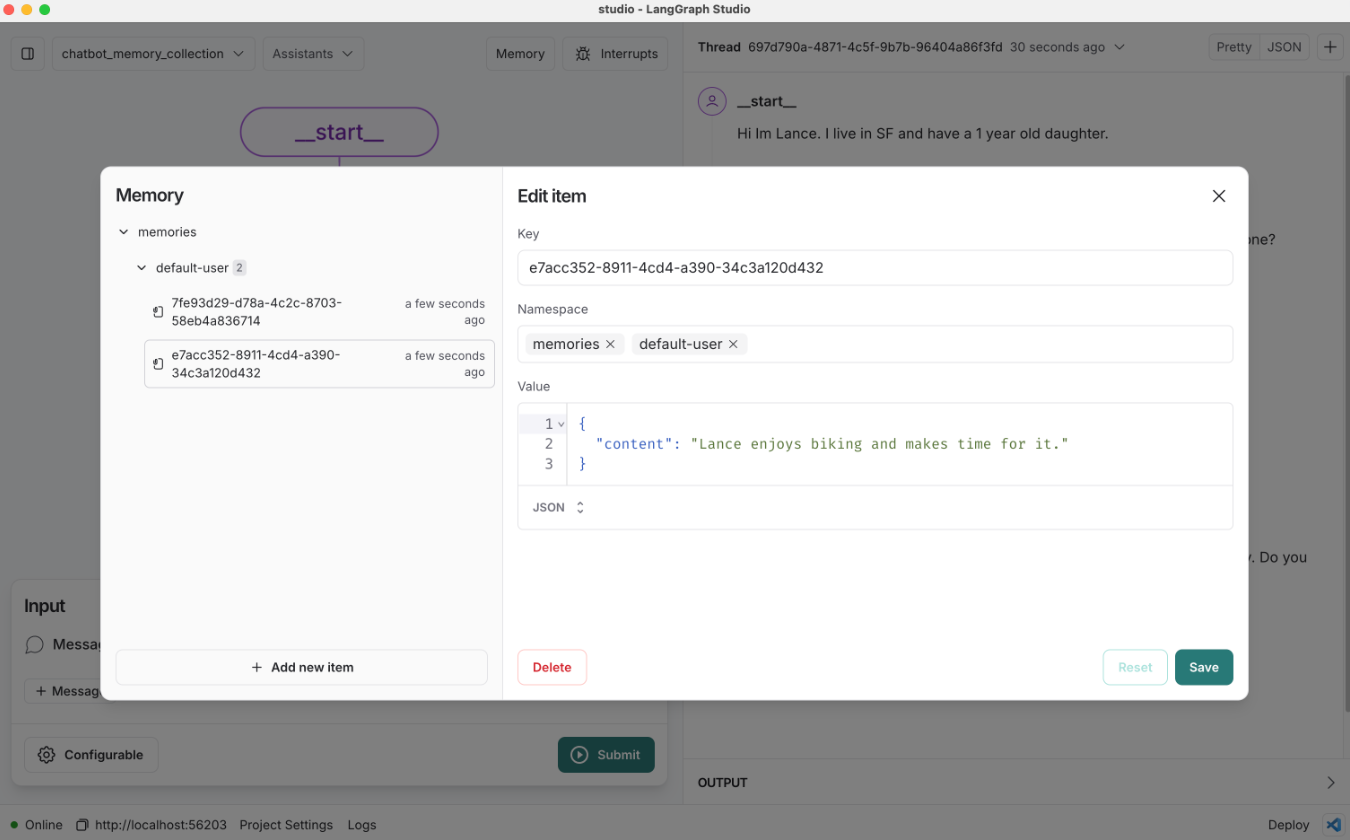
스튜디오